
Open interest (OI)
Open interest is the total of all open positions in a coin’s perpetual contracts. Each new position (a long with a short on the other side) increases OI, each close or liquidation decreases it. Liqdar adds up the OI of three exchanges: Binance, Bybit and OKX, USDT- and USDC-margined contracts.
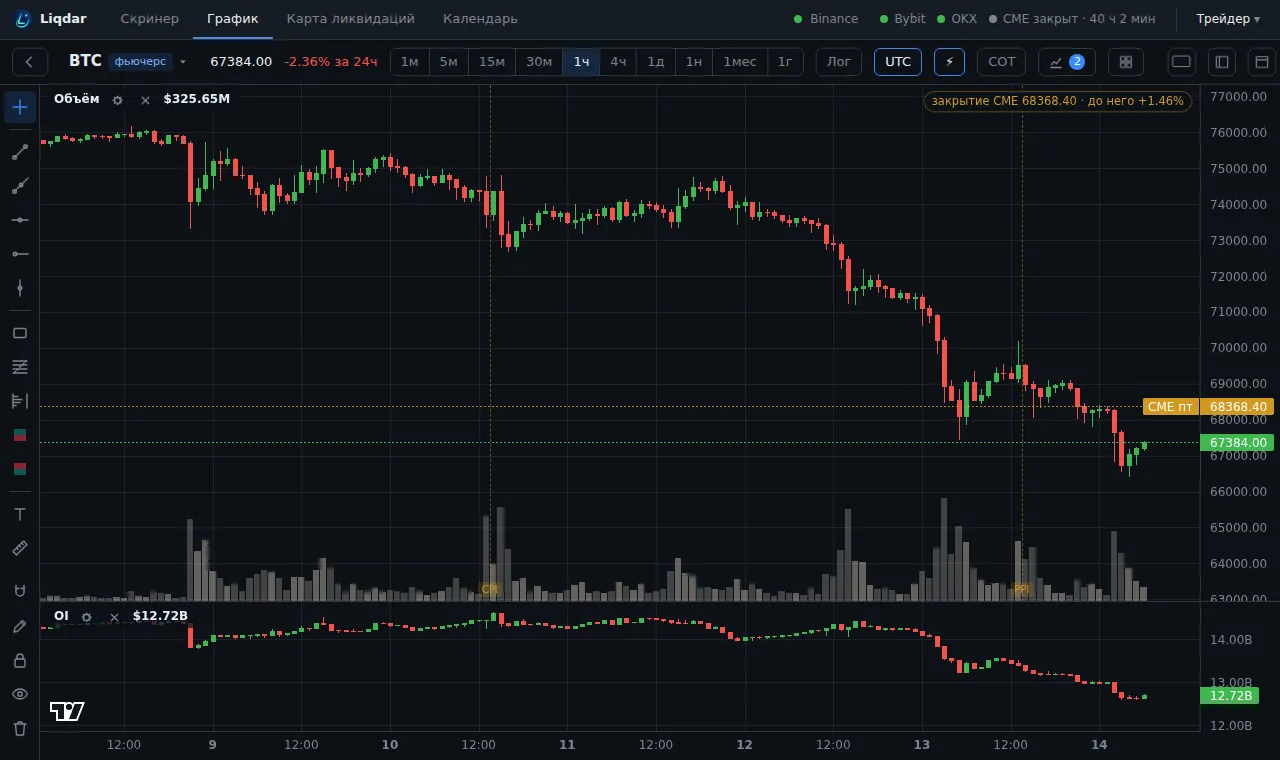
How to read it
Section titled “How to read it”OI alone says nothing about direction: every long has a short. It gets meaning together with price.
| Price | OI | What is happening |
|---|---|---|
| ↑ rising | ↑ rising | new money is coming in: longs are being built (or shorts against the move); the move is backed |
| ↑ rising | ↓ falling | shorts are closing, a rally on covering; it may run out |
| ↓ falling | ↑ rising | shorts are being built |
| ↓ falling | ↓ falling | longs and liquidations are leaving; often the end of the drop |
A sharp OI rise in a range is position building: a move is coming, and one side will be flushed. A sharp OI drop on a long candle means mass liquidations.
Settings
Section titled “Settings”Exchanges («Биржи»)
Section titled “Exchanges («Биржи»)”Binance, Bybit, OKX: which exchanges to add up. Default: all three.
Contracts («Контракты»)
Section titled “Contracts («Контракты»)”USDT and USDC: which contracts to add up. OKX has no USDC contracts. Default: both.
Units («Единицы»)
Section titled “Units («Единицы»)”- USD: the value of positions in dollars. Grows both from new positions and from a rising price.
- Coins («Монеты»): the number of coins in positions. Shows the net inflow of positions without the price effect.
Default: USD.
Show («Показывать»)
Section titled “Show («Показывать»)”- Sum («Сумму»): one line or candles over all selected exchanges.
- By exchange («По биржам»): a separate line for each exchange and contract, to see where positions are built.
Default: Sum.
Sum style («Стиль суммы»)
Section titled “Sum style («Стиль суммы»)”Candles (OI open, high, low and close inside the candle) or Line. Default: Candles.
Data source and history depth
Section titled “Data source and history depth”The server stores the OI of all contracts every 5 minutes and keeps it forever. Before our collection started there is exchange history: Binance keeps 30 days, OKX at 5 minutes about 5 days. Candles are built from finer readings (15-minute ones for 1h). If a contract’s history starts later, it joins the sum from its first point; the legend shows this.